Human rights e-learning
Canadian Centre for Housing Rights: a right-to-housing course for City staff
Learning Design Consultant (self-employed) · Canadian Centre for Housing Rights · Jul – Oct 2026



The problem
CCHR’s program helps City of Toronto staff apply a human rights-based approach to housing in their work.
The audience is wide: about 1,000 staff across a variety of roles. The self-paced course gives everyone the same foundation first, and it has to be sufficient for staff who do not attend the instructor-led training.
I joined the project in its late-design stage as a course design hand-off, eager to help out despite the important constraints. The content was largely decided, and because it had gone through legal review, I couldn’t change the writing. The task was to make the course engaging and useful without changing or adding content.
Why a self-paced foundation
The course serves as a knowledge foundation, whereas instructor-led training will be a follow-on for leaders. The self-paced course will serve staff across many roles and needs to support the development of shared vocabulary and definition of a human rights-based approach to housing.
The approach
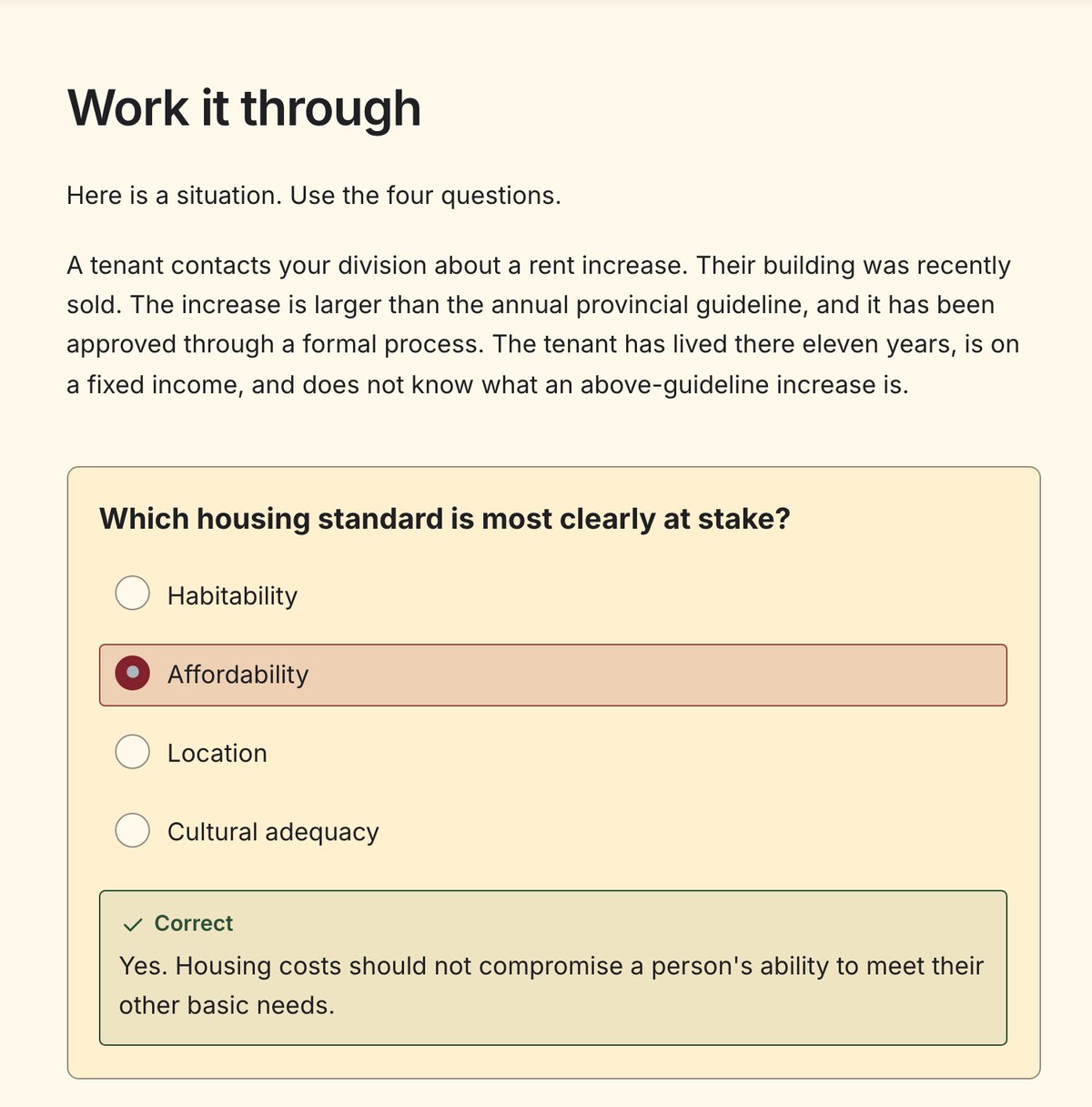
The approved content already included a short set of questions staff can ask about any housing situation. The framework had passed legal review because it asks staff to consider and check, rather than stating what the City owes. I built a practice activity around it: a reflection worksheet introduced at the start of the course, where staff apply the questions to one situation from their own work. Later modules point them back to it. That moves the course from foundational knowledge toward application, and gives staff something to bring to the instructor-led training.
The existing learning outcomes weren’t measurable, so I refined them and distributed them across the modules. I also recommended changes to clarify the knowledge check writing.
CCHR provided an approved transcript. From it, I drafted each slide’s content, layout and images. I reformatted the text into columns, cards, stats and quotes where they help people remember and apply it, without changing the words. The watercolour visuals, based on Toronto reference photos, show places and people without photographing anyone in housing distress. I recommended the narration voices and generated the audio from the same transcript.
I took the course through two major design iterations. I checked every page for accessibility, including heading structure and the knowledge checks.
A direction that didn’t make it in time
Early on, I proposed scenarios that would anchor the learning in real situations. One screen told a documented case: a 90-unit building in Weston, sold in 2013 to Canada’s largest landlord, followed by four above-guideline rent increase applications in five years (from Above Guideline Rent Increases and Financialization in Ontario, 2026). A practice scenario then asked staff to respond to a tenant facing a similar increase, and showed what colleagues in other divisions might notice. The review timeline didn’t leave room to add them.
Two-hour narrated self-paced course for about 1,000 City of Toronto staff, launching fall 2026.
Working on something like this? I'd like to hear about it. hello@arielharlap.com