Evaluation & research
Innovation Lab: redesigning how students learn to innovate
Innovation Lab Coordinator · Concordia University · Jan 2021 – Aug 2022
The problem
The Innovation Lab invites Concordia students from all faculties to spend a term working in teams on challenges brought by external partners. Participation is extracurricular, and challenge-based learning is new to almost every participant. The syllabus they were handed was built on IDEO’s Design Thinking approach, which didn’t align well with the lab’s challenge-based pedagogy or its values — and students had little supporting material for forming teams or practising design research.
The approach
I coordinated the lab and iteratively redesigned its learning materials, treating student feedback as the input that drove each round.
For the syllabus, I explored several design approaches — Human-Centred Design, Pluriversal Design, Equity-Centred Community Design, Design Justice, the Double Diamond — and settled on the Systemic Design Approach (British Design Council, 2021), for its systems thinking, its inclusion of nature as a stakeholder, and its treatment of storytelling and leadership as enabling activities for design. I reorganized each week into a consistent format — design phase, topics, meetings, readings, tasks, tools — and varied the formats of learning materials following Universal Design for Learning guidelines. The new structure noticeably reduced student questions about deliverables, tasks, and schedule.
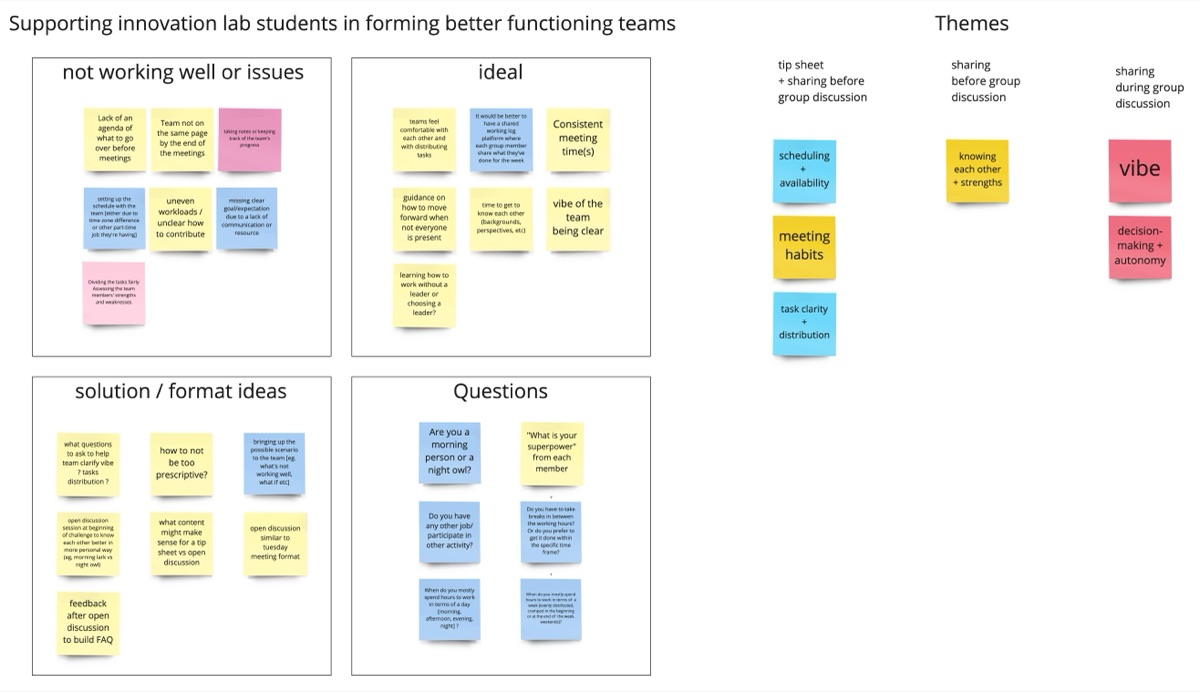
Feedback kept shaping the work. When students reported uneven workloads in their teams, I facilitated an ideation session with lab alumni and built a team-forming discussion guide: nine topics that scaffold a team’s first real conversation, ending with documented agreements the team signs and shares with the lab. When it was clear students struggled most when mentors weren’t engaging, I wrote a mentorship guide for prospective challenge partners. And because starting design research is the hardest part, I developed guides on the exploration methods students needed first.
What came of it
In the Winter 2021 final feedback survey, 100% of students who responded reported the experience was overwhelmingly positive and felt heard and included — 83% of students answered the optional, anonymous survey. That’s certainly not solely attributable to the syllabus, but it was the signal we were working toward.
The methodology became a peer-reviewed publication on the living lab approach (Revue Interventions Économiques, 2022, with A. L. Davidson and N. Bhuiyan). I also carried out a research prospectus and critical literature review toward a more student-centred model — when surveyed, 85% of applicants were interested in bringing their own challenge topics.
Every survey respondent reported the experience as overwhelmingly positive (83% of students responded), and the method became a peer-reviewed publication.
Working on something like this? I'd like to hear about it. hello@arielharlap.com